

Start here for some highlights. The full report tells the whole story.
Key Findings at a Glance
92%

of clients say equivalent legal support would have been inaccessible, difficult, or only available at significant cost.
150,000+
estimated hours of pro bono legal work contributed over two decades.
82%
report value creation to a large or very large extent (55% choosing “very large”).
$90M
estimated social value at current market rates.
93%
rate the match between law firm expertise and organizational needs as good or very good.
9.7/10
collaborator Net Promoter Score, with 94% promoters and zero detractors.
9.4/10
client Net Promoter Score for the Foundation (85% promoters).
100%
Every collaborator that used the Foundation for its own legal needs said it reinforced their confidence in referring others.

Letter from the Managing Director
Twenty years ago, our founders had an idea. Partners at Lex Mundi’s Washington, D.C. and Massachusetts member firms, one a Lex Mundi Board member, spent time traveling the world, meeting pioneers in the social impact space and asking a question that nobody had asked before: What would it look like if the extraordinary legal talent inside this global network were turned toward the world’s most urgent problems? What they found was a largely unmet need for transactional legal support among the mission-driven organizations working on the front lines of poverty, climate, health, education, and human rights. And what they built, from that conviction, was the Lex Mundi Pro Bono Foundation.
This report is what twenty years of answering this question looks like.
Since 2006, 138 Lex Mundi member firms have worked alongside nearly 1,400 social enterprises and nonprofits on well over 3,000 legal matters across 120 countries. For the first time, through an independent impact assessment, we can put a credible number on what that commitment represents: an estimated $90 million in pro bono legal services, freely given to organizations working on some of the most consequential problems of our time.
When I first saw that figure, it stopped me cold. Not because I doubted this network, but because $90 million brings into focus the scale of what has been built over two decades. It is the cumulative force of thousands of individual acts of generosity, expertise, and care, delivered by the best law firms in their respective jurisdictions, to organizations that would otherwise have had no path to that quality of counsel.
The organizations on the receiving end of that generosity feel it acutely. Ninety-two percent of clients told us that equivalent legal support would have been inaccessible or unaffordable without the Foundation. A trademark secured at a critical moment. A new market entered. An investment unlocked. A governance structure that allowed a founder to finally focus on their mission instead of their legal exposure. Our client satisfaction score of 9.4 out of 10 tells us these engagements are not just useful. They are transformative.
We are proud of what this community has built. Deeply, genuinely, proud. And that is the reason we cannot stop here.
The world that social entrepreneurs and nonprofit leaders are operating in today is in some ways more challenging than the one our founders surveyed twenty years ago. The landscape of philanthropic and government funding has shifted dramatically. Access to justice is under pressure in ways that would have been difficult to imagine a decade ago and the communities that mission-driven organizations serve are bearing the weight of this instability most acutely.
We enter our third decade with the proof of concept firmly in hand, a growing body of thought leadership shaping the environment in which social enterprises operate, and a network of firms whose commitment to this work continues to deepen. What we built was never just a matchmaking service. It was an argument, made through action over twenty years, that pro bono legal expertise belongs in the hands of the organizations changing the world.
That argument has been heard. The work of ensuring it reaches further, sustains itself, and continues to grow is the work ahead.
To the attorneys across this network who have given their time, their expertise, and their genuine care: this report belongs to you. To the foundations, donors, and member firms whose financial commitment makes our work possible: we are profoundly grateful. And to the social entrepreneurs and nonprofit leaders we serve: we are proud to be in your corner, and we are not going anywhere.
The next twenty years begin now. We are glad you are in this with us.


Isis Bous
Managing Director
Lex Mundi Pro Bono Foundation
Twenty Years in Context
When the Lex Mundi Pro Bono Foundation was established in 2006, pro bono legal work looked very different than it does today.
In the West, many law firms were likely to have formal pro bono programs. But the work itself was concentrated almost entirely on traditional legal aid: criminal defense, immigration, housing, and family law. The client was understood to be an individual in crisis, not an organization with a mission. Across much of the rest of the world, structured pro bono practices were rare.
Social entrepreneurs and nonprofit leaders, those building innovative solutions to the world’s most pressing problems, were simply not part of the conversation. A few isolated efforts were beginning to offer transactional legal support to small charities, but these were the exception rather than the rule, limited in scope, concentrated in a few western markets, and focused on the most traditional nonprofit structures. Mission-driven organizations, including for-profit entities requiring sophisticated transactional counsel, were not considered qualified pro bono clients. This meant that thousands of organizations working on global health, climate resilience, gender equality, economic inclusion, and more did not have a realistic path to the legal expertise required
to sustain their operations and scale their work.
The Lex Mundi Pro Bono Foundation sought to change this.
From day one, the Lex Mundi Pro Bono Foundation focused exclusively on transactional legal services for mission-driven organizations, work that no one else was systematically providing on a pro bono basis. We built the infrastructure to match complex legal needs with qualified firms across jurisdictions at a time
when cross-border pro bono simply did not exist as a practice. We made the case to Lex Mundi member firms, the leading independent law firms in their respective countries and regions, that social entrepreneurs and nonprofit leaders deserved the same quality of legal counsel as their corporate clients. That pro bono was one of the most powerful tools a law firm had for making a difference in the world. And we took that argument everywhere, including places where the concept of structured pro bono was entirely new.
Over the twenty years that followed, the landscape changed dramatically. Transactional pro bono for mission-driven organizations moved from the margins to the mainstream. Intermediary models emerged and spread. Eligibility frameworks expanded. Firms that had never engaged in formal pro bono programs began to build them. The global pro bono movement grew into something substantial and lasting. We do not claim sole credit for that transformation.
“I am so pleased that Lex Mundi Pro Bono is thriving after all these years. My colleague, Barry White, from our Massachusetts firm, came up with the idea of utilizing the power of our global membership to provide pro bono legal assistance to social entrepreneurs. He and I pitched the idea to Carl Anduri (Lex Mundi’s President at the time) and Lex Mundi’s executive committee in late 2005. With some skepticism they approved the concept, I set up a 501c3, and the rest is history. Thanks to the leadership of Chloe Holderness and then Isis Bous, the firms took hold and delivered.”
Dave Roll
Founder, Lex Mundi Pro Bono Foundation
Former Partner and Chair, Steptoe, Washington, DC
What we built, and what this network demonstrated was possible, helped show the world a new way to think about what pro bono could be and who it could serve.
20 Years of Impact
2006-2026
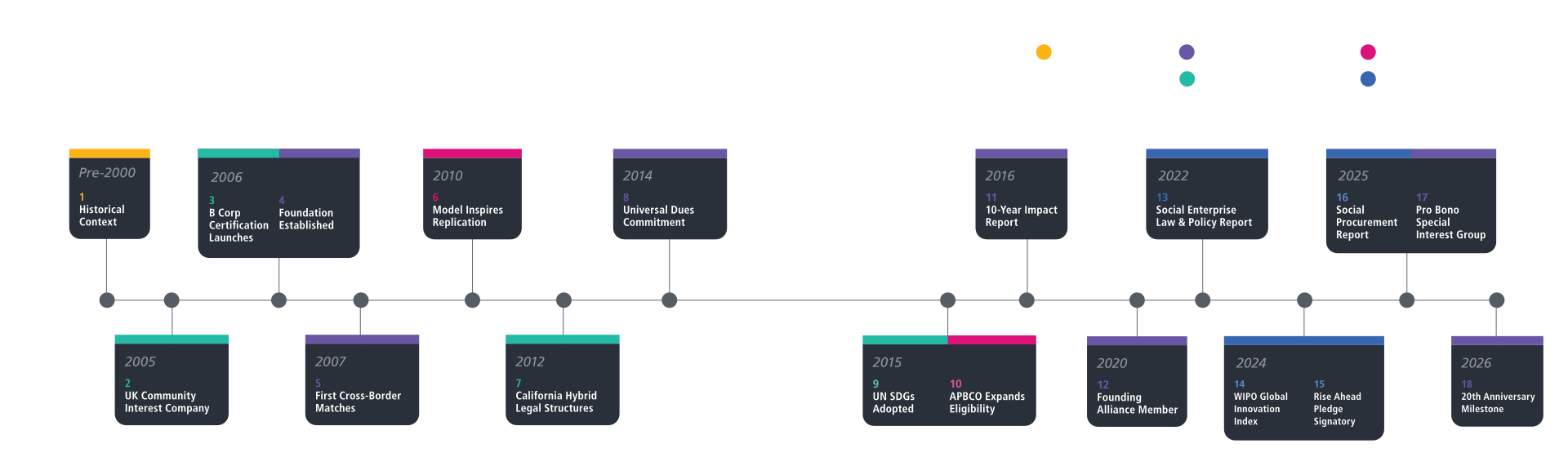
1. Historical Context
A small number of organizations begin offering isolated transactional pro bono legal support to charities, but this is largely limited to conventional nonprofits in Western markets. While organizations such as Ashoka, Echoing Green, the Schwab Foundation for Social Entrepreneurship, and the Skoll Foundation have been established to identify and support the world’s leading social entrepreneurs, they still typically lack access to legal assistance. The Foundation soon fills this gap and these capacity-building organizations, among others, become the Foundation’s earliest collaborators.
2. UK Community Interest Company:
The UK introduces the Community Interest Company (CIC), the first major government-recognized hybrid legal structure featuring a strict asset lock to protect community interests.
3. B Corp Certification Launches
B Lab is incorporated and launches the B Corp Certification framework, formally recognizing for-profit companies with social and environmental missions.
4. Foundation Established
The Lex Mundi Pro Bono Foundation is established as the first global pro bono network dedicated to providing transactional legal services to social entrepreneurs.
5. First Cross-Border Matches
The Foundation begins matching social entrepreneurs with member firms across jurisdictions, providing cross-border transactional pro bono support at a scale that had not previously existed.
6. Model Inspires Replication
Other organizations begin developing similar intermediary models for transactional pro bono support, validating the approach the Foundation pioneered four years earlier.
7. California Hybrid Legal Structures
California officially launches the Public Benefit Corporation (PBC) and the Flexible/Social Purpose Corporation (SPC), creating a mainstream corporate blueprint for the venture-backed startup ecosystem. While Maryland was the first U.S. state to pass benefit legislation in 2010, California’s 2012 activation, followed closely by Delaware in 2013, served as the primary catalyst for mass adoption over the next decade across more than 40 U.S. States and triggered a wave of global evolution, heavily inspiring international statutes like Italy’s Società Benefit (2015), Colombia and Latin America’s BIC framework (2018), and France’s Entreprise à Mission (2019).
8. Universal Dues Commitment
Every Lex Mundi member firm commits to supporting the Foundation through annual
dues, providing stable, recurring funding and full institutional backing.
9. UN SDGs Adopted
The United Nations adopts 17 Sustainable Development Goals, providing a universal framework for measuring and aligning social enterprise impact.
10. APBCO Expands Eligibility
The Association of Pro Bono Counsel expands its eligibility framework to recognize social enterprises as appropriate pro bono clients, bringing the Foundation’s mission further into the mainstream nine years later.
11. 10-Year Impact Report
The Foundation publishes its first comprehensive impact report, documenting 95 member firms supporting more than 450 social entrepreneurs across 57 countries.
12. Founding Alliance Member
The Foundation is a founding member of the COVID Response Alliance for Social Entrepreneurs (now The Global Alliance for Social Entrepreneurship), an initiative by the Schwab Foundation for Social Entrepreneurship in partnership with the World Economic Forum. In the first months of the pandemic, the Foundation coordinates guidance on government support across 104 jurisdictions.
13. Social Enterprise Law & Policy Report
The Foundation coordinates 66 Lex Mundi member firms across 83 jurisdictions to conduct research for the landmark Social Enterprise Law & Policy Report, which launches at the World Economic Forum’s annual meeting in Davos. It is subsequently cited by the OECD, WEF, and Geneva Centre for Philanthropy.
14. WIPO Global Innovation Index
The World Intellectual Property Organization (WIPO) incorporates the Foundation’s Social Enterprise Law & Policy Report into the 2024 Global Innovation Index, and the Foundation
is recognized as a strategic partner at the launch event.
15. Rise Ahead Pledge Signatory
The Foundation becomes one of 13 original signatories of the Rise Ahead Pledge at Davos, alongside organizations including Microsoft, SAP, EY, and the Bayer Foundation.
16. Social Procurement Report
Lex Mundi member firms contribute expertise across 39 jurisdictions to the State of Social Procurement 2025 report, which launches at the World Economic Forum Annual Meeting.
17. Pro Bono Special Interest Group
The Foundation launches a Pro Bono Special Interest Group to connect professionals across the Lex Mundi network, drawing participants from 45 member firms across every region at its first meeting.
18. 20th Anniversary Milestone
The Foundation marks its 20th anniversary
as an independent impact assessment
confirms $90M in donated legal services, 3,000+ projects matched, ~1,400 social enterprises supported and 120 countries reached since inception.
There’s so much more to see.
Dive into the full report to find the story behind our $90 million estimate, how our work reaches all 17 UN Sustainable Development Goals and every region of the world, client case studies and snapshots, and what clients, firms, and collaborators told us in their own words. You’ll also find the recognition our work has earned, where we’re headed next, and how you can join us.